

In this article, I Invite you & your nose deep into the highlands of a landlocked country known for its vertiginous altitude, deadly roads and endless salt flats… Bolivia!
Whilst planning my backpacking trip to South-America some years ago, I just knew I had to include a visit to the world’s largest salt flats: the Salar de Uyuni! Little did I know I would end up loving the parts of the tour exploring the surrounding Altiplano much, much more!
(Don’t worry though – I’ll be sure to cover nature’s master of optical illusion in another post).
This with volcanoes surrounded, 170,000 km² large area of land is a high-elevation plain located in the central Andes region at an average altitude of about 4,000m (13, 123 ft)! Its bulk lies in Bolivia, but it also occupies parts of Chile, Peru and Argentina.
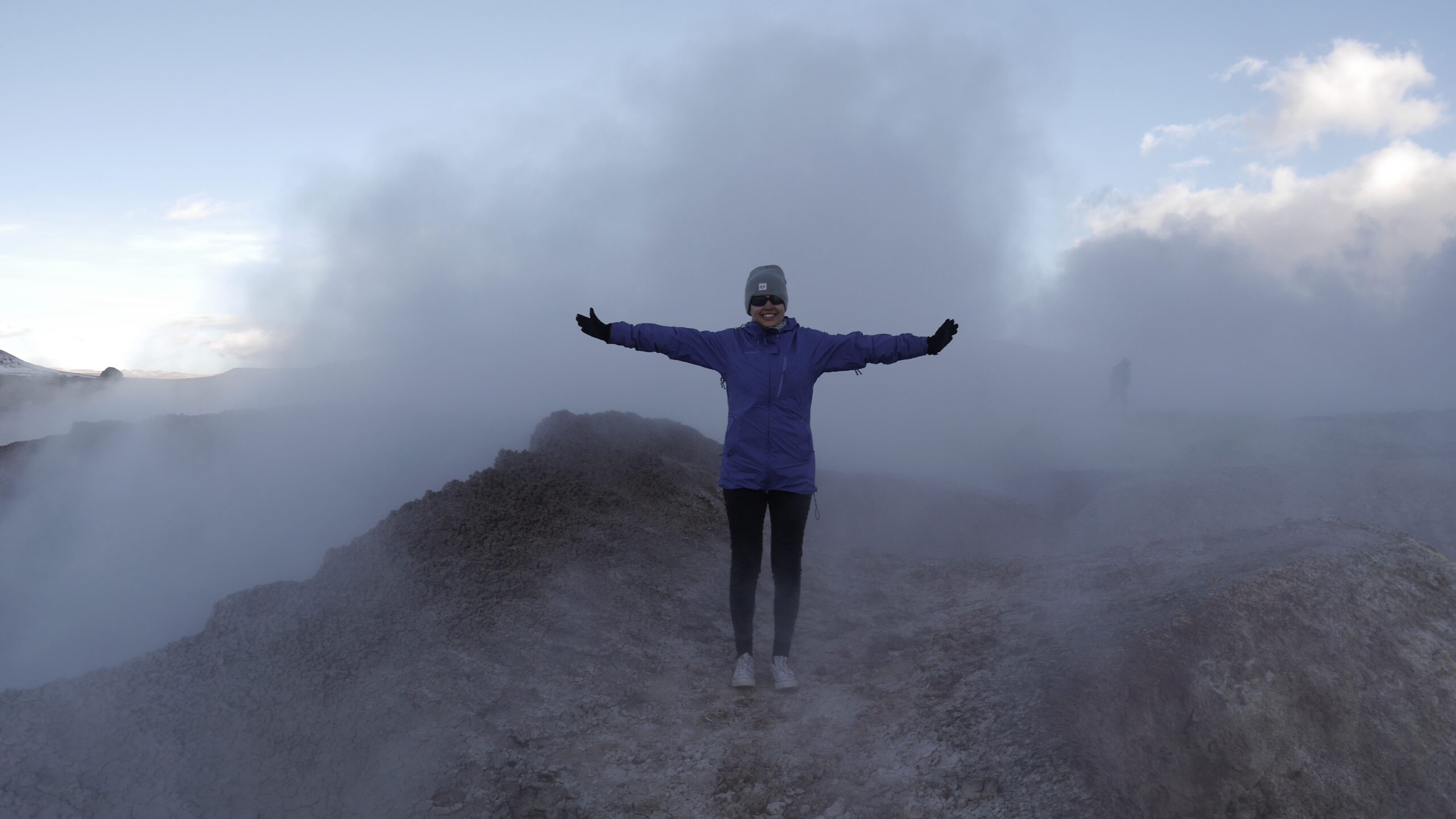
On the tour, we explored several of its highlights – including the smelly geysers of Sol de Mañana (Spanish for ‘morning sun’), whose scent left an indelible trace in my memory.
This field of geysers is an active geothermal area, lined with bubbling mud lakes and fuming steam pools. Fed by underlying volcanic activity, the fumaroles (i.e. vents in the surface of the earth) emit a thick cloud of steam mixed with volcanic gasses, REEKING of sulfur. Remarkable, considering we detect significantly less smell at high altitudes and the geysers are located at almost 5,000 meters!
Now, I can imagine you wonder why I believe a rotten egg smell makes for a ‘great travel experience’. Yet, if there’s one thing I want you to take away from this article it’s that it is not solely the subjective level of (un)pleasantness of the scent that defines our experience, but also its origin and what it communicates to us about the environment.
Think about it: the repelling smell warns us that we are approaching an area with extremely hot, possibly toxic natural geological activity (how cool!). In fact, our sense of smell is considered our most rapid warning system. Research has shown that the area of the brain processing smells reacts more rapidly to negative smells associated with unease and threat, than to positive smells. What’s more, it sends a direct signal to the ‘movement areas’ of our brain to trigger a physical avoidance response.
Talk about instinctively ‘smelling danger’!
Funnily enough, pure sulfur (a non-metallic chemical building block) is odorless. The ‘rotten egg smell’ we associate with sulfur is actually caused by the presence of hydrogen sulfide gas (H2S), which is created naturally by decaying organic matter. In the fumaroles, the gas is formed when microorganisms dine on sulfur deposits inside volcanoes. It then reaches our nose mixed with other volcanic gasses, such as water vapor, carbon dioxide and sulfur dioxide.
On a closing remark, the Sol de Manana geysers have often been described as “otherworldly” or “extraterrestrial” because of the moon-like landscape and thick gas clouds (which, I kid you not, can reach heights of 50 (!) meters). Yet, how much more ‘worldly’ can it get than this? Some craters even have lava flow depending on the month; giving us just the tiniest sneak peek into all that resides inside the earth, right beneath our very own feet!
Oh yes.
Go smell Earth’s breath. I found it… breathtaking.



Practical information
Tip #1: There are several night buses running from the capital of Bolivia (La Paz) to Uyuni, the town closest to the salt flats. Please note that the salt flats can also be visited from San Pedro de Atacama in Chile.
Tip #2: I booked my 4 days/ 3 nights tour with the company Red Planet (in Uyuni) and was very satisfied with the service. If you love beautiful light, I would recommend looking for a tour agency that visits the geysers with sunrise, as the site is especially beautiful in the morning sun (hence its name!).
Tip #3: It is recommended to bring high-altitude glasses/ good quality sunglasses because of the high UV index (10+).
Tip #4: If you are afraid of getting high-altitude sickness, don’t worry: the guides carry oxygen with them in case of an emergency. I was also served some coca tea (there was also the option of chewing the leaves); a natural remedy that helps you cope with the altitude.
Final word of advice: visitors are allowed to roam freely around the site, but please make sure you are accompanied by a professional guide, especially if you are visually impaired! If you accidentally trip and fall into one of the 250 degrees Celsius-hot pools, you’ll be cooked in seconds…

