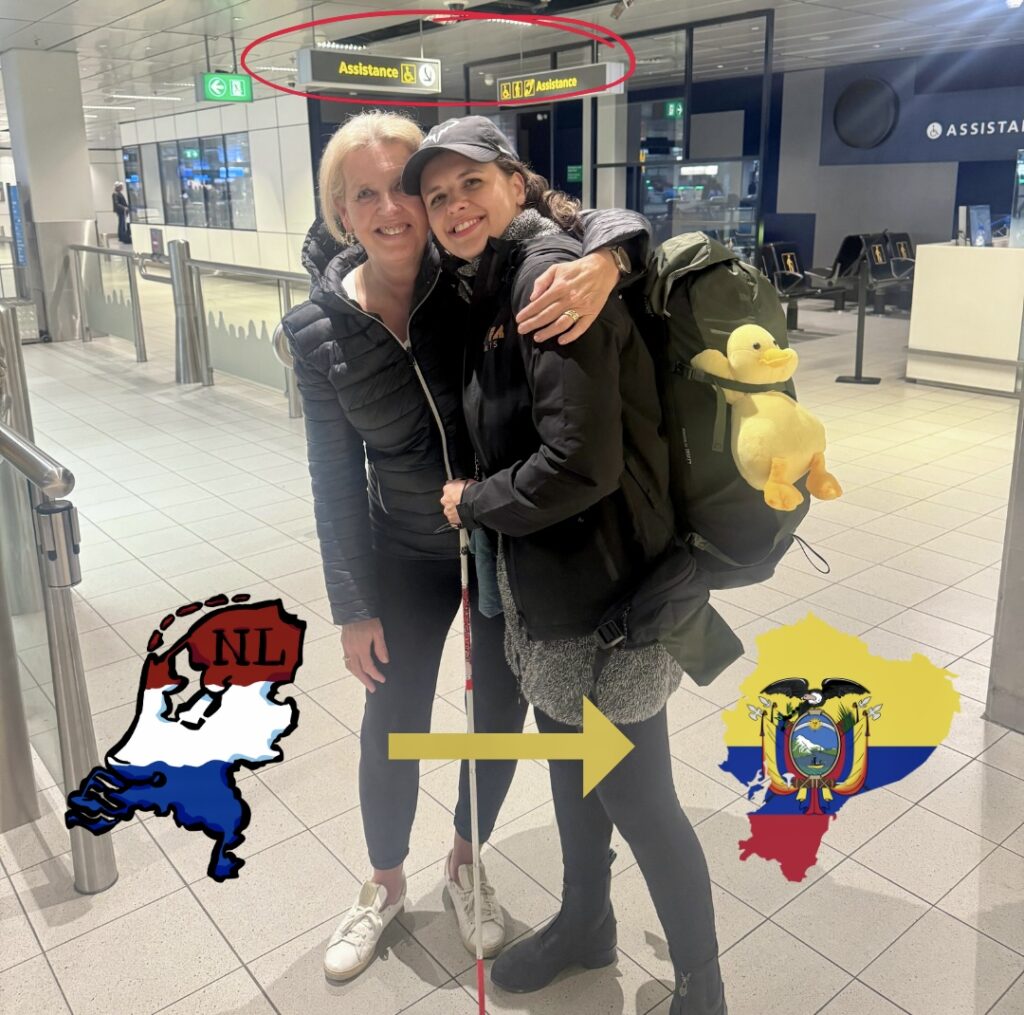
Writing to you for the first time from Ecuador, the country where I will be volunteering and traveling for the months to come! On my way here, I received assistance both at Amsterdam and Quito airport. Here, I will share my best tips and tricks for getting comfortable with this type of travel help.
Opening yourself up to receiving help 🫱🏼🫲🏿
For my flight to Quito, Ecuador, I asked for assistance immediately when booking my ticket (yup, I checked the box).
Usually, on flights within Europe, I will approach the airport staff — carrying my ID cane — right before the boarding call, and ask them whether I can board the plane with the assistance passengers. This way, a crew member can help me find my seat and I receive just the right kind of help (tip!).
But this time, I would be taking an intercontinental, 11-hour flight, requiring me to not only go through security, but also customs, both in the Netherlands, and in a whole new country. I think we all know how impatient people get in these queues.
It was time to officially ask for assistance.
Opening yourself up to receiving help can be a difficult process — but it’s also an important one. Assistance can save you huge amounts of time, stress and effort. Precious energy that can be redirected into other areas of your travel.
It does not take away from your independence as a person, or as a traveler.
In fact, knowing when to lean on another person and truly accept help is an act of bravery and self-love, not weakness.
It has taken me (too) long to realize that.
Deciding not to take a travel, because you are scared or ashamed of asking for help, now that’s in my opinion, where you lose independence.
Please let that be the core message of this article.

Practical + Emotional Tips 🫶🏽
Okey! Now that that’s clear — let’s dive into the tips:
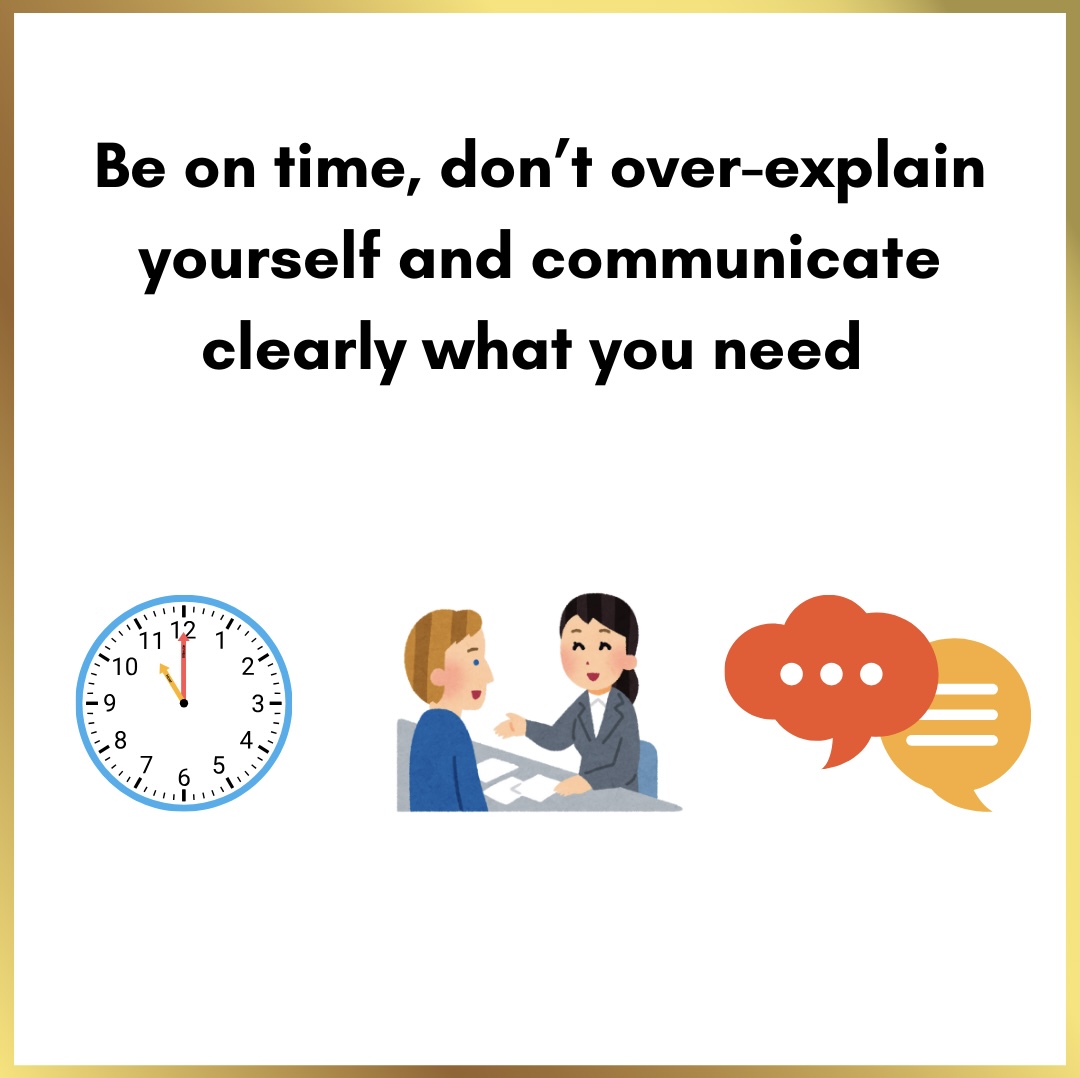
A) Don’t over-explain yourself 🗣️
Oversharing is so 2024 (but oh, have I been guilty of it…) ! Please don’t feel like you owe the person assisting you an explanation of what medical condition you have or exactly how disabled you are.
Focus on communicating what it is that you need your assistant to do (or not do).
For example, I requested assistance because of my difficulty navigating new spaces. I kindly communicated to the worker that I needed him to buy me time at security & customs and guide me to my gate. Then, upon arrival at Quito, I communicated again to the local crew that I didn’t need a wheelchair (they were waiting for me with one), but rather a guide to customs and the luggage belt as I was unfamiliar with Quito airport. That was it.
If you use an assistive device, such as a cane, you could also share how you would like it to be handled AND whether you are comfortable with your assistant taking your arm.
I have found that assistants have the tendency to do that automatically, with good intentions, but without permission.
B) Arrive to the airport early ⏰
Yes, receiving assistance saves travel time — but it can take a while before the person giving you assistance actually shows up.
At Amsterdam airport, I had to present myself at a so-called assistance desk. Localizing such a desk can take some time, especially if you are low vision, so I would definitely ask a ground crew member to help you find it.
Upon presentation, I had to wait about 20-30 minutes before the employee assisting me actually showed up. I got the impression that this was pretty common practice, at least in Amsterdam.
Though it is the responsibility of the airport to get you to your gate on time, I would strongly recommend arriving early, just in case there are any problems with the staff or the communication.
It’s nice to still have some time for a drink, or some tax-free shopping, right?
Remember: only YOU know if you need assistance or not 💪🏽
Do you need a certain ‘level of disability’ before you can request assistance?
No. At least not in my opinion.
Of course, you shouldn’t abuse the system and ask for assistance as a non-disabled person looking to buy time (unfortunately, this happens too much…).
But — if you are (partially) disabled, please don’t worry about what your assistant might think.
I, for example, still have functional vision and — with the zoom function of my phone — could find the gate, customs area and luggage belt myself.
But the assistance saved me so much stress, and above all, energy.
If you feel like you will benefit from it, ask for it!
C) Practice your cognitive scripts 🧠
As a final tip, I recommend memorizing some ‘cognitive scripts’.
These are rehearsed, standardized sentences that you can use in situations where you feel a little uncomfortable, but need to communicate yourself nonetheless.
For example, you could practice saying: “I have a (…) disability, please could you help me find my gate.” Or: “I can walk by myself thank you, I do not feel comfortable with you taking my arm.”
Practicing these sentences beforehand, in a safe space, will help you get them out in the more difficult moments.
Alternatively, you could write them down in your notes and show them to your assistant. There’s no shame in doing that!
Enjoy the journey! 🤩
The best thing about assistance? It means you get to travel!
Focusing on this end goal has always helped me get through uncomfortable situations.
New experiences are waiting… and I’ll be sure to share more from Ecuador soon!
If you have any questions or doubts, please feel free to reach out through my social media (@beyondmyblur). ❤️
Warmly,
Marie Elise